
Last reviewed: October 10, 2026
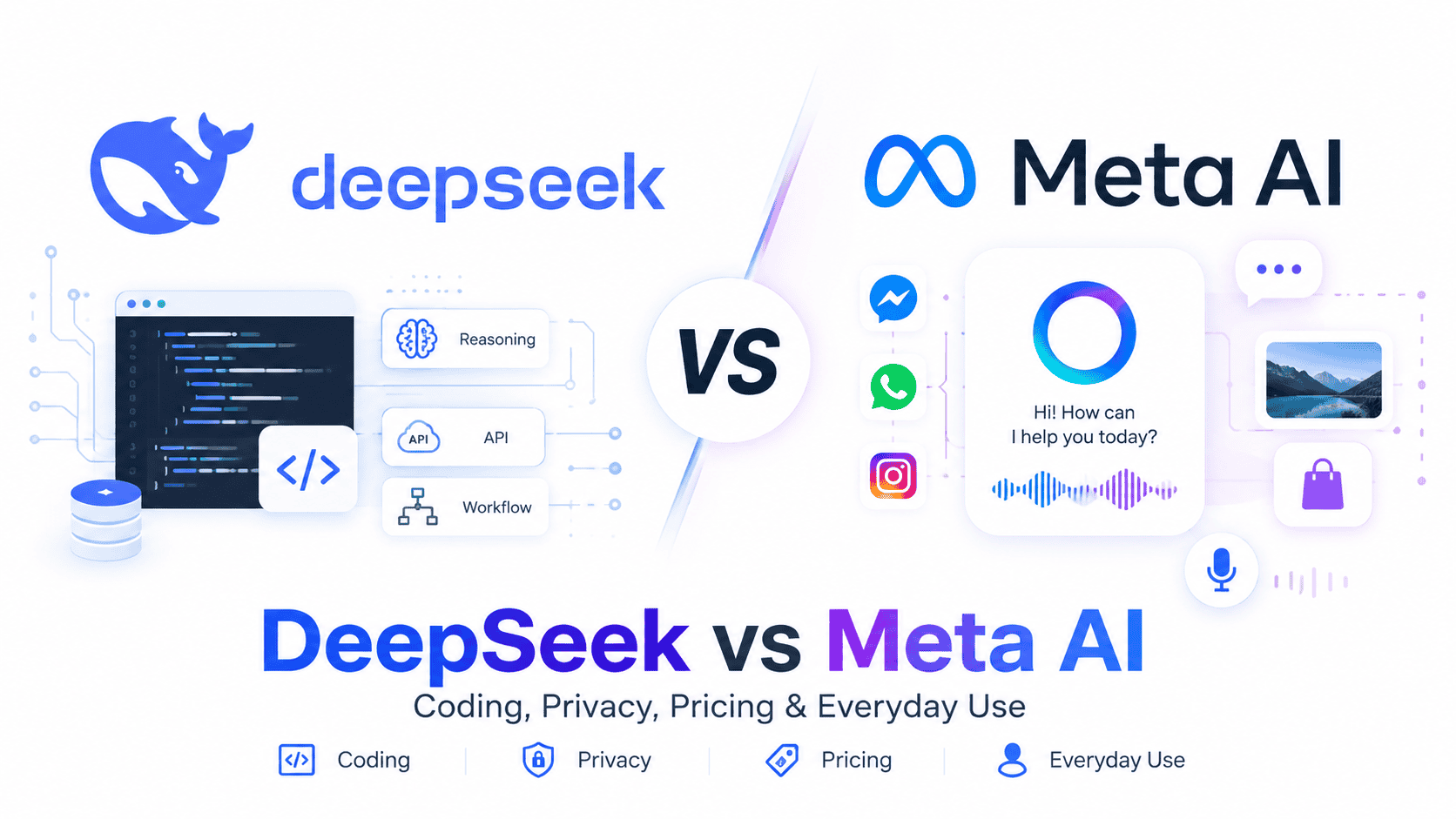
DeepSeek vs Meta AI is not a simple chatbot-versus-chatbot comparison. DeepSeek can mean the DeepSeek app, DeepSeek Web, the DeepSeek API, current hosted model IDs such as deepseek-flash and deepseek-v4-pro, or open-weight model releases. Meta AI can mean the consumer assistant at Meta.ai, the standalone Meta AI app, Meta AI inside WhatsApp, Instagram, Messenger, and Facebook, or the separate Meta Model API with Muse Spark, Muse Image, Muse Voice Transcribe, SAM, and other models.
The practical answer: choose DeepSeek when your priority is low-cost hosted text generation, long-context workflows, OpenAI-compatible and Anthropic-compatible access, context-caching economics, or open-weight experimentation. Choose Meta AI when your priority is an everyday assistant inside Meta apps, image creation, social discovery, shopping, local recommendations, and consumer voice interaction.
For developers, separate the audio capabilities carefully. Muse Spark can reason over supported audio and video inputs and returns text, but audio understanding in Muse Spark 1.3 is not fully supported, and Meta warns that response quality may be degraded. Meta recommends Muse Spark 1.2 for general audio-input tasks, or Muse Voice Transcribe when the goal is dedicated speech-to-text. Neither Muse Spark nor Muse Voice Transcribe is documented as a general text-to-speech or speech-to-speech API.
That distinction also separates the consumer product from the developer platform. Meta AI may offer a spoken conversational experience in supported apps and rollouts, but this does not mean Meta Model API exposes the same voice experience as a public speech-generation endpoint. App voice, audio understanding, transcription, and audio generation are four different capabilities.
Do not reduce this comparison to DeepSeek R1 vs Meta AI. DeepSeek R1 remains important as an open-weight reasoning family, but current DeepSeek API work should begin with current model IDs. DeepSeek’s current table lists deepseek-flash as DeepSeek-V4.1-Flash and deepseek-v4-pro as DeepSeek-V4-Pro-0813. DeepSeek Models & Pricing
Likewise, do not treat Meta AI as “just Llama.” Meta AI is a consumer assistant, Meta Model API is a hosted developer platform, and Llama or Muse Glimmer are separate open-weight paths. Meta Model API models
DeepSeek vs Meta AI at a glance
Use this table as a starting point. The right choice depends on whether you need a consumer assistant, a developer API, an audio pipeline, an open-weight model, or a business workflow.
| Use case | Better starting point | Why |
|---|---|---|
| Low-cost hosted text API calls | DeepSeek | deepseek-flash has low listed token prices, especially for off-peak and cache-hit input. |
| Everyday assistant inside WhatsApp, Instagram, Messenger, or Facebook | Meta AI | Meta AI is integrated into Meta’s social and messaging products. |
| OpenAI-compatible and Anthropic-compatible API access | Both developer platforms | DeepSeek documents both formats; Meta Model API also exposes OpenAI-compatible Chat Completions and Anthropic-compatible Messages surfaces. |
| Image generation and editing | Meta AI or Muse Image | The consumer assistant offers image workflows, while muse-image-1.0 is the dedicated API image model. |
| Audio understanding and questions about a recording | Muse Spark 1.2 | Meta says Muse Spark 1.3 audio support is incomplete and recommends 1.2 for audio-input tasks. |
| Production speech-to-text | Muse Voice Transcribe | It is Meta’s dedicated transcription model with streaming and file endpoints. |
| Spoken consumer conversation | Meta AI app experience | This is a consumer-product feature and should not be confused with the Model API’s transcription endpoints. |
| Text-to-speech or speech-to-speech API | Neither Muse Spark nor Muse Voice Transcribe | The documented Muse Voice model returns transcript text and does not synthesize speech. |
| Image understanding | Both | deepseek-flash supports Vision, while Muse Spark supports image understanding. |
| Open-weight experimentation | Depends | DeepSeek offers V4.1 Flash and R1 weights; Meta offers Llama and Muse Glimmer paths with different licenses. |
| Business and customer messaging on Meta channels | Meta ecosystem | Meta’s products are designed around WhatsApp, Instagram, Facebook, Messenger, ads, and commerce. |
| Privacy-sensitive business use | Review both | Consumer products, API tiers, open weights, and third-party deployments have different data-use terms. |
What is being compared: app, API, model, or open weights?
The biggest mistake in a DeepSeek vs Meta AI comparison is mixing product layers. DeepSeek API pricing is not comparable to Meta AI’s consumer access. A voice conversation in the Meta AI app is not the same as Muse Voice Transcribe. An open-weight checkpoint is not the same as a hosted chatbot.
| Layer | DeepSeek | Meta |
|---|---|---|
| Consumer assistant | DeepSeek app and DeepSeek Web. | Meta AI at Meta.ai, in the Meta AI app, and inside supported Meta apps. |
| Developer API | DeepSeek API with OpenAI-compatible and Anthropic-compatible formats. | Meta Model API with Muse Spark, Muse Image, Muse Voice Transcribe, and SAM. |
| Main hosted text/agent model | deepseek-flash and deepseek-v4-pro. | muse-spark-1.3, 1.2, and 1.1. |
| Dedicated transcription model | No equivalent in the DeepSeek sources reviewed for this comparison. | muse-voice-transcribe-1.0. |
| Image-generation model | Not the primary API offering in the checked documentation. | muse-image-1.0. |
| Social ecosystem | Not a primary advantage. | WhatsApp, Instagram, Messenger, Facebook, Meta.ai, and the Meta AI app. |
| Open weights | DeepSeek-V4.1-Flash, DeepSeek-R1, and other releases. | Llama models and Muse Glimmer, with model-specific licenses. |
| Privacy context | App, API, open platform, self-hosting, and third-party use differ. | Consumer Meta AI, Meta apps, Standard API, Contributor API, and open weights differ. |
Current DeepSeek status: app, API, models, and open weights
DeepSeek is an AI company and platform with a consumer assistant, web chat, API platform, and open-weight releases. For current hosted API work, the main starting model is usually deepseek-flash, which DeepSeek identifies as DeepSeek-V4.1-Flash. The current table also lists deepseek-v4-pro as DeepSeek-V4-Pro-0813. DeepSeek Models & Pricing
DeepSeek says deepseek-flash supports Thinking Mode, JSON Output, Tool Calls, Responses API, Anthropic API, Chat Prefix Completion, FIM in non-thinking mode, and Vision. Vision is currently listed for Flash, not Pro.
DeepSeek’s V4.1 Flash release tells developers to use deepseek-flash and treats older V4 Flash identifiers as compatibility names served by the newer Flash model. DeepSeek V4.1 Flash release note
For open-weight use, the official V4.1 Flash model card lists an MIT license and deployment paths through inference runtimes and providers. Open weights provide deployment control, but operating a large model remains infrastructure-intensive. DeepSeek-V4.1-Flash model card
Current Meta AI status: app, Muse models, Llama, and Model API
Meta AI is Meta’s consumer assistant, available through Meta.ai, the Meta AI app, and supported experiences inside WhatsApp, Instagram, Messenger, and Facebook. Consumer features can include text chat, images, files, recommendations, research-style tasks, and spoken interaction depending on the surface, account, region, and rollout. Meta AI assistant
Meta Model API is separate. It currently documents five model families: Muse Spark for text, coding, agents, and multimodal understanding; Muse Image for image generation and editing; Muse Voice Transcribe for speech-to-text; SAM for image and video segmentation; and Muse Glimmer as a self-hosted open-weight model. Meta Model API models
Muse Spark has three hosted versions. Meta recommends muse-spark-1.3 for new agentic and coding work, but its audio support has an explicit limitation: audio understanding in 1.3 is not fully supported, and response quality for requests containing audio may be degraded. Meta recommends muse-spark-1.2 for audio-input workflows or Muse Voice Transcribe for dedicated speech-to-text.
| Meta model or product | Input | Output | Best use | Important limitation |
|---|---|---|---|---|
| Meta AI consumer app | User text, voice, images, files, and product-specific context. | Consumer assistant responses, including spoken interaction where available. | Everyday questions and Meta-app workflows. | Product capability; not a promise of equivalent public API endpoints. |
muse-spark-1.3 | Text, images, video, audio, and PDF. | Text. | New coding, reasoning, and agent workflows. | Audio understanding is not fully supported; quality may be degraded. |
muse-spark-1.2 | Text, images, video, audio, and PDF. | Text. | Audio/video understanding and general multimodal reasoning. | It is a general reasoning model, not the dedicated transcription product. |
muse-voice-transcribe-1.0 | Streaming audio or supported audio files. | Transcript text. | Meetings, calls, dictation, captioning, and voice-agent transcription. | No speech generation, speech-to-speech conversation, or word-level timestamps. |
muse-image-1.0 | Text and optional images. | Image. | Image generation and editing. | Separate from Muse Spark and voice functions. |
| Muse Glimmer | Depends on self-hosted deployment. | Model-generated text and supported multimodal results. | Local agent experiments. | Not served through Meta Model API. |
DeepSeek vs Meta AI for everyday users
For everyday users, Meta AI has the stronger convenience story because it is available where many people already message, browse, create, and shop. DeepSeek offers a more independent assistant and appeals more directly to users interested in its models, technical responses, API economics, or open-weight ecosystem.
| Everyday task | Better starting point | Why |
|---|---|---|
| Quick questions and general writing | Either | Compare answer quality, speed, interface, and privacy comfort. |
| Using AI inside Meta apps | Meta AI | It is embedded in Meta’s consumer ecosystem. |
| Spoken assistant interaction | Meta AI | Voice conversation is a user-facing product capability on supported surfaces. |
| Image creation and editing | Meta AI | The consumer product provides image workflows. |
| Independent chatbot outside Meta’s ecosystem | DeepSeek | DeepSeek app and Web are standalone AI experiences. |
| Developer-backed, text-heavy workflows | DeepSeek | DeepSeek’s API prices can be attractive for high-volume text processing. |
| Open-weight experimentation | Depends | Both ecosystems publish model weights, but hardware and licenses differ. |
DeepSeek vs Meta AI inside WhatsApp, Instagram, Facebook, and Messenger
This is Meta AI’s clearest consumer advantage. Users can access the assistant in supported Meta products instead of opening a separate developer application or building an integration.
Meta AI is especially useful when the workflow involves social discovery, images, shopping, local recommendations, Instagram or Facebook inspiration, and conversations inside Meta’s messaging products. DeepSeek can assist with writing, coding, summarization, and reasoning, but it does not have equivalent native placement across Meta’s apps.
Meta has also announced Incognito Chat for certain Meta AI surfaces. That is a specific mode with its own availability and limitations; it should not be used to describe every Meta AI conversation. Meta Incognito Chat announcement
DeepSeek vs Meta AI for coding and agents
For coding and agents, compare DeepSeek API with Meta Model API, not only the consumer assistants. DeepSeek offers low token prices, long context, Context Caching, Thinking Mode, Tool Calls, JSON Output, and compatible API formats. Meta offers Muse Spark, Responses API state, streamed tool-call arguments, parallel tool calls, search grounding, and a 1M-token context window.
Use muse-spark-1.3 as Meta’s recommended starting model for new coding and agent work. Do not infer from its multimodal input list that it is also the recommended model for audio-heavy agents. If the workflow depends on understanding a recording or a video’s soundtrack, test Muse Spark 1.2; if the task is transcription, use Muse Voice Transcribe.
| Coding or agent need | Better starting point | Why |
|---|---|---|
| Low-cost repeated text calls | DeepSeek | deepseek-flash lists lower direct text-token prices than Muse Spark Standard. |
| New Muse coding and agent workflows | Muse Spark 1.3 | Meta recommends 1.3 for agentic, browser, coding, and long-horizon tasks. |
| Audio-aware agent that must reason over recordings | Muse Spark 1.2 | Meta warns that 1.3 audio support is incomplete. |
| Voice agent transcription layer | Muse Voice Transcribe | It provides streaming ASR, diarization, endpointing, and turn-level timestamps. |
| Agent that speaks back to the user | Requires a separate speech-output solution | Muse Voice Transcribe is speech-to-text only, and Muse Spark returns text. |
| Search-grounded agent | Meta Model API | Meta exposes a built-in web_search tool. |
| OpenAI-compatible or Anthropic-compatible migration | Both | Both providers document compatible surfaces, with provider-specific features and limits. |
| Local coding-agent experiment | Depends | DeepSeek open weights and Muse Glimmer can both be evaluated. |
DeepSeek API vs Meta Model API
DeepSeek API is primarily a model API with low token pricing and DeepSeek-specific reasoning, caching, Vision, and compatibility features. Meta Model API is a multi-model platform: Muse Spark handles text and multimodal reasoning, Muse Image generates images, Muse Voice Transcribe handles speech-to-text, and SAM performs segmentation.
| Developer need | DeepSeek API | Meta Model API |
|---|---|---|
| Main text/code model | deepseek-flash or deepseek-v4-pro. | muse-spark-1.3, 1.2, or 1.1. |
| Base API formats | OpenAI-compatible and Anthropic-compatible. | OpenAI-compatible Chat Completions, Responses API, and Anthropic-compatible Messages. |
| Image understanding | deepseek-flash. | Muse Spark. |
| Audio understanding | Not a primary documented feature in the DeepSeek sources reviewed. | Muse Spark; use 1.2 for audio because 1.3 support is incomplete. |
| Dedicated speech transcription | No direct equivalent covered here. | muse-voice-transcribe-1.0. |
| Text-to-speech or speech-to-speech | No direct equivalent covered here. | Not provided by Muse Voice Transcribe; no general Muse Spark audio-output endpoint is listed. |
| Image generation and editing | Not the main API focus in checked docs. | muse-image-1.0. |
| Segmentation | Not a primary API focus. | sam-3.1. |
| Search grounding | Usually requires your own retrieval or search integration. | Built-in web_search tool. |
| Open weights | V4.1 Flash, R1, and other releases. | Muse Glimmer and Llama models, separate from Model API. |
Pricing and cost: DeepSeek API vs Meta AI app vs Meta Model API
Do not compare DeepSeek API token charges with Meta AI’s consumer access as if they are the same product. DeepSeek API, Meta Model API, transcription, image generation, segmentation, and self-hosting use different billing units.
DeepSeek’s current table lists deepseek-flash off-peak rates of $0.003 per 1M cache-hit input tokens, $0.15 per 1M cache-miss input tokens, and $0.60 per 1M output tokens. Peak prices are double. DeepSeek Models & Pricing
Meta Model API’s Standard Muse Spark tier lists $0.15 per 1M cached-input tokens, $1.25 per 1M regular input tokens, and $4.25 per 1M output tokens. The Contributor tier is cheaper but permits Meta to use prompts and completions for training. Meta Model API pricing
Muse Voice Transcribe is not billed with Muse Spark token prices. It is billed separately at $0.18 per hour of audio processed, with the same rate for streaming and file transcription. Meta bills audio time as a separate line item, rounded down to whole seconds.
| Cost layer | Billing unit | Current example price | Important condition |
|---|---|---|---|
| DeepSeek Flash off-peak input/output | Per million tokens | $0.15 uncached input; $0.003 cached input; $0.60 output | Peak rates are double. |
| Muse Spark Standard | Per million tokens | $1.25 input; $0.15 cached input; $4.25 output | Prompts and completions are not used for training. |
| Muse Spark Contributor | Per million tokens | $0.10 input; $0.002 cached input; $0.20 output | Discounted in exchange for training permission. |
| Muse Voice Transcribe | Per audio duration | $0.18 per processed hour | Speech-to-text only; not Muse Spark token billing. |
| Muse Image | Per generated image | $0.01 per returned image | Failed or filtered images are not counted. |
| Web search grounding | Per search query | $2.50 per 1,000 queries | Added to the request’s token cost. |
The correct cost comparison depends on the task. A transcription product should compare accuracy and cost per processed audio hour. A coding agent should compare total text tokens and accepted changes. A consumer voice chat cannot be priced from Muse Voice Transcribe alone because it may include separate recognition, reasoning, product orchestration, and speech-output components.
Audio and voice: understanding, transcription, and generation are different
“Voice support” is too broad to be useful. A product may accept spoken input, understand the meaning of a recording, create a written transcript, generate spoken audio, or provide a low-latency speech-to-speech conversation. These capabilities require different models and interfaces.
| Capability | What it means | Meta option | Current limitation |
|---|---|---|---|
| Consumer voice conversation | User speaks to an assistant and receives an interactive response. | Meta AI app or supported Meta surfaces. | Product feature; availability and behavior can vary and do not define the public Model API. |
| Audio understanding | Ask questions about the meaning, events, or content of a recording. | Muse Spark 1.2 is the safer current choice. | Meta says 1.3 audio support is incomplete and quality may be degraded. |
| Audio transcription with a general model | Ask a multimodal reasoning model to write the spoken words. | Muse Spark 1.2. | Reasoning shares the output budget; long audio may require streaming and a large output allowance. |
| Dedicated speech-to-text | Convert live or recorded speech into transcript text. | Muse Voice Transcribe. | No speech synthesis, speech-to-speech, word-level timestamps, sound-event detection, or emotion detection. |
| Text-to-speech | Convert written text into generated audio. | No dedicated Meta Model API family listed in the checked catalog. | Do not infer a TTS API from Meta AI’s app voice experience. |
| Speech-to-speech | Receive speech and generate spoken responses in a continuous interaction. | Consumer Meta AI may provide an app experience. | Muse Voice Transcribe explicitly does not provide a speech-to-speech API. |
Muse Spark 1.3 audio limitation
Meta lists audio among the accepted input modalities for muse-spark-1.3, but attaches an explicit warning: audio understanding is not fully supported, and the response quality for audio-containing requests may be degraded. This means an accepted request should not be treated as evidence that 1.3 is the best audio model.
Use Muse Spark 1.3 for the coding and agent workloads for which Meta recommends it. Use Muse Spark 1.2 when your task depends on understanding or transcribing an audio recording, and validate the results against the source.
Muse Spark audio understanding vs transcription
Muse Spark is a general multimodal reasoning model. It can summarize a recording, answer questions about spoken content, analyze a video and its soundtrack together, extract structured details, or produce a transcript. Its response is text.
For transcription through Muse Spark, Meta’s current examples use muse-spark-1.2. Meta also warns that reasoning uses the same output budget as the transcript, so a low max_tokens or max_output_tokens value can produce an empty or truncated transcript. Long audio may need streaming or lower reasoning effort.
Muse Voice Transcribe is the dedicated ASR model
muse-voice-transcribe-1.0 is designed for live and recorded speech-to-text. It supports streaming speaker diarization, voice-activity detection, endpointing, contextual and keyword biasing, code-switching across evaluated languages, and turn-level timestamps.
Its output is transcript text. Meta explicitly says it does not synthesize speech, provide speech-to-speech conversation, return word-level timestamps, detect sound events, or detect emotion. Choose it for reliable transcription infrastructure, not for a speaking assistant.
Meta AI app voice is not the same as the Model API
A user may be able to speak to Meta AI and hear a response in a supported consumer interface. That experience can combine speech recognition, an assistant model, product state, and speech playback behind the scenes.
Developers should not assume that the same end-to-end voice stack is exposed through Meta Model API. The current API catalog documents Muse Spark as text-output reasoning, Muse Voice Transcribe as audio-to-text, Muse Image as image output, and SAM as segmentation. A voice-agent application that must speak may need a separate speech-generation service.
Multimodal comparison: images, files, video, and audio
Meta has the broader set of specialized media products, while DeepSeek offers image understanding through deepseek-flash and competitive economics for text-heavy processing. The correct Meta model changes with the media task.
| Capability | DeepSeek | Meta |
|---|---|---|
| Image understanding | deepseek-flash supports Vision. | Muse Spark supports image understanding. |
| Image generation and editing | Not the primary checked API feature. | Muse Image is the dedicated generation/editing model. |
| Video understanding | Not a primary documented DeepSeek API focus in the sources used. | Muse Spark can analyze video and embedded audio, returning text. |
| Audio understanding | Not a primary checked DeepSeek API feature. | Use Muse Spark 1.2; 1.3 audio quality may be degraded. |
| Speech-to-text | No dedicated option covered here. | Muse Voice Transcribe is the production-focused ASR model. |
| Speech generation | No dedicated option covered here. | No dedicated public Model API family listed in the checked model catalog. |
| Consumer voice assistant | Verify current DeepSeek app behavior. | Meta AI provides a consumer voice experience where available. |
| Segmentation | Not a primary API focus. | SAM 3.1 returns boxes and masks for images and video. |
| File handling | Depends on the DeepSeek endpoint and workflow. | Meta Responses API and Files API support reusable media/file inputs. |
Privacy and data-use comparison
Privacy depends on the product layer. DeepSeek app/API, Meta AI consumer use, Meta Model API Standard, Meta Model API Contributor, and open-weight self-hosting are separate contexts.
DeepSeek’s Privacy Policy says it may collect prompts, voice input, uploaded files, photos, feedback, chat history, device and network information, and other data. It also says personal data is directly collected, processed, and stored in China for the services. DeepSeek Privacy Policy
Meta’s consumer AI policies and system cards apply to Meta AI use. A consumer voice conversation should not be assumed to have the same retention, training-use, or contractual terms as Meta Model API.
Meta Model API Standard says prompts and completions are not used to train Meta models. The lower-priced Contributor versions of Muse Spark trade discounted pricing for permission to use prompts and completions for training. Muse Voice Transcribe does not offer the Contributor training-eligible tier at launch.
| Privacy question | DeepSeek | Meta |
|---|---|---|
| Consumer prompts and media | DeepSeek says prompts, files, photos, voice input, feedback, and chat history may be collected. | Consumer Meta AI is governed by Meta’s product and privacy documentation. |
| Standard paid API training use | Review DeepSeek’s Open Platform terms and policies. | Meta Model API Standard says data is not used for model training. |
| Discounted API tier | No directly equivalent tier in this comparison. | Muse Spark Contributor permits training use of prompts and completions. |
| Transcription | No dedicated path compared here. | Muse Voice Transcribe has separate audio pricing and no Contributor tier at launch. |
| Self-hosting | Specific DeepSeek open-weight models can be self-hosted. | Llama and Muse Glimmer can be self-hosted under their respective licenses. |
| Sensitive information | Requires approval and data-flow review. | Requires approval and review of the exact app, API tier, and deployment. |
Do not send passwords, API keys, client files, medical records, legal documents, financial data, trade secrets, private source code, or regulated information without an approved data-processing and security path.
Open weights and self-hosting
DeepSeek and Meta both have open-weight paths, but those paths are separate from their consumer assistants and hosted APIs.
DeepSeek-V4.1-Flash is published through an official Hugging Face model card that lists an MIT license. DeepSeek-R1 remains an important open-weight reasoning family. Self-hosting still requires compute, serving software, storage, monitoring, security, and engineering. DeepSeek-V4.1-Flash model card
Meta’s open-weight ecosystem includes Llama models and Muse Glimmer. Muse Glimmer is separate from Muse Spark: Glimmer is downloaded and run on your own hardware, while Spark is served through Meta Model API. Muse Glimmer announcement
For a decision about downloadable Llama checkpoints rather than the Meta AI assistant, see our DeepSeek vs Llama comparison.
Do not assume that a hosted capability transfers to an open-weight model. Meta AI’s consumer voice interface, Muse Spark’s hosted audio inputs, and Muse Voice Transcribe’s streaming ASR are not automatically features of a local Llama or Muse Glimmer deployment.
Business use: Meta channels vs DeepSeek-powered workflows
For businesses already operating on WhatsApp, Instagram, Facebook, Messenger, ads, or commerce, Meta’s ecosystem can reduce integration work. Meta AI and business-oriented Meta products can fit customer messaging and social workflows more naturally.
DeepSeek-powered business workflows are usually custom-built: support bots, internal tools, document processing, coding assistants, RAG systems, and agent pipelines. DeepSeek may be the stronger option when model/API control and text-token economics matter more than native Meta-channel integration.
For a voice-enabled business workflow, design the stack explicitly. Speech recognition may use Muse Voice Transcribe; reasoning may use Muse Spark or another model; speech generation may require another service. Do not describe all three stages simply as “Meta AI voice.”
Which one should you choose?
Choose DeepSeek if API cost and model control matter most
Choose DeepSeek if your priority is low-cost hosted text calls, long-context work, compatible API formats, JSON Output, Tool Calls, Context Caching, or open-weight experimentation. It is especially attractive for high-volume coding, extraction, classification, and text-agent workflows.
Choose Meta AI if social-app convenience matters most
Choose Meta AI when you want an everyday assistant inside Meta’s consumer ecosystem, including supported image, shopping, local discovery, and spoken-interaction features. Treat those as app capabilities, not as a specification for Meta Model API.
Choose Muse Spark 1.3 for new coding and agent work
Meta recommends Muse Spark 1.3 for new agentic, browser, coding, and long-horizon tasks. Use it when the workflow is primarily text, images, tools, files, or coding. Do not choose it as the default for audio-heavy work until Meta removes or changes the current audio-support warning.
Choose Muse Spark 1.2 for audio understanding
Use Muse Spark 1.2 when you need a general reasoning model to summarize a recording, answer questions about audio, interpret a video’s soundtrack, or produce a text transcript as part of a wider multimodal task.
Choose Muse Voice Transcribe for production transcription
Use Muse Voice Transcribe for live captions, meetings, calls, dictation, speaker attribution, and high-volume transcription. Add a separate speech-output service if the application must speak back to the user.
Choose open weights when deployment control matters
Choose DeepSeek open weights, Llama, or Muse Glimmer when you need downloadable models and can manage infrastructure, license requirements, security, and serving quality. Do not assume hosted app or API features are included in the checkpoint.
Decision matrix
| Your priority | Recommended starting point | What to verify |
|---|---|---|
| Low-cost text API | deepseek-flash | Peak/off-peak timing, cache hits, output volume, quality, and privacy fit. |
| Everyday AI inside Meta apps | Meta AI | Surface availability, limits, privacy, and voice rollout. |
| New coding or tool-using Meta agent | Muse Spark 1.3 | Tool reliability, coding quality, latency, and Standard vs Contributor terms. |
| Questions about an audio recording | Muse Spark 1.2 | Accuracy, output budget, supported formats, and long-audio latency. |
| Live or file speech transcription | Muse Voice Transcribe | Language accuracy, diarization, rate limits, privacy, and $0.18/hour pricing. |
| Text-to-speech or speaking voice agent | Add a separate speech-output model or service | Do not assume Muse Voice Transcribe generates audio. |
| Image generation and editing | Meta AI or Muse Image | Consumer limits, API cost, output rights, and safety filtering. |
| Open-weight local experiments | DeepSeek, Llama, or Muse Glimmer | License, hardware, runtime, quantization, and feature differences. |
| Business messaging on Meta channels | Meta ecosystem | Channel availability, terms, business tools, and integration cost. |
| Privacy-sensitive work | Neither by default | Exact product, API tier, training use, retention, residency, and approval. |
Common mistakes and misconceptions
| Misconception | More accurate answer |
|---|---|
| “Muse Spark 1.3 fully supports audio because audio is listed as an input.” | Meta explicitly says audio support in 1.3 is not fully supported and quality may be degraded. |
| “Use the newest Muse Spark version for every task.” | Use 1.3 for new coding and agent work, but use 1.2 for audio-input workflows under current guidance. |
| “Audio understanding and transcription are the same.” | Understanding involves reasoning over content; transcription focuses on converting speech to text. |
| “Muse Voice Transcribe is a voice-chat model.” | It returns transcript text and does not synthesize speech or provide speech-to-speech conversation. |
| “Meta AI app voice means Meta Model API has a TTS endpoint.” | The consumer app and developer API are separate products. No dedicated TTS family is listed in the checked Model API catalog. |
| “Muse Spark generates audio.” | Its documented output modality is text. |
| “Muse Voice Transcribe provides word-level timestamps.” | Meta documents turn-level timestamps, not word-level timestamps. |
| “DeepSeek vs Meta AI is just R1 vs Llama.” | Both companies operate multiple apps, APIs, hosted models, and open-weight paths. |
| “Meta Model API Standard and Contributor have the same data-use rules.” | Standard says data is not used for training; Contributor permits training use for discounted pricing. |
| “Open weights mean free production inference.” | Self-hosting still requires compute, storage, security, monitoring, and engineering. |
Frequently asked questions
Is DeepSeek better than Meta AI?
DeepSeek is often the better starting point for low-cost text API workloads, long context, compatible API formats, and open-weight experiments. Meta AI is stronger for consumer access inside Meta apps, social workflows, images, and product-level voice interaction.
Is Meta AI better than DeepSeek?
Meta AI is often better for everyday users who already use WhatsApp, Instagram, Messenger, or Facebook. DeepSeek can be better for custom developer workflows and model experimentation.
Does Muse Spark 1.3 support audio?
It accepts audio as an input modality, but Meta says audio understanding in Muse Spark 1.3 is not fully supported and response quality may be degraded. Use Muse Spark 1.2 for audio understanding or Muse Voice Transcribe for dedicated speech-to-text.
What model should I use to understand a recording?
Use Muse Spark 1.2 under Meta’s current guidance. It can summarize, answer questions, extract details, or transcribe audio while returning a text response.
What model should I use for speech-to-text?
Use muse-voice-transcribe-1.0 when transcription is the main task. It supports live streams and supported files, speaker attribution, voice-activity detection, endpointing, and turn-level timestamps.
Can Muse Voice Transcribe generate speech?
No. Meta says it is speech-to-text only. It does not synthesize speech or provide a speech-to-speech conversation API.
Does Muse Voice Transcribe provide word-level timestamps?
No. Meta documents turn-level timestamps, but not word-level timestamps. It also does not provide sound-event or emotion detection.
How much does Meta transcription cost?
Muse Voice Transcribe is currently listed at $0.18 per hour of audio processed. Streaming and file transcription use the same price, and audio time is billed separately from Muse Spark token usage.
Is Meta AI voice the same as Muse Voice Transcribe?
No. Meta AI voice is a consumer assistant experience. Muse Voice Transcribe is a developer API model that converts speech into transcript text. It does not create the assistant’s spoken reply.
Does Meta Model API have text-to-speech?
The current model catalog checked for this article does not list a dedicated text-to-speech family. Muse Voice Transcribe is speech-to-text, and Muse Spark outputs text. Developers who need spoken output should verify whether Meta adds a speech-generation model or use another approved service.
Can Muse Spark transcribe audio?
Yes, Muse Spark can produce a transcript as a text response. Meta’s current audio examples use Muse Spark 1.2, not 1.3. For production transcription features such as realtime streaming and speaker labels, Muse Voice Transcribe is the more direct choice.
Can Muse Spark understand video audio?
Yes. Meta documents video understanding that processes visual frames and embedded audio together. For workflows where the soundtrack is critical, account for the current Muse Spark 1.3 audio limitation and test Muse Spark 1.2.
Which is better for coding?
Test DeepSeek and Muse Spark 1.3 on the same repository. DeepSeek can be attractive for low-cost long-context calls, while Muse Spark 1.3 is Meta’s recommended model for new coding and agentic work.
Which is cheaper, DeepSeek or Meta Model API?
For Standard-tier text-token calls, deepseek-flash lists lower rates than Muse Spark Standard. Muse Spark Contributor is heavily discounted but permits Meta to train on prompts and completions. Transcription uses separate per-hour pricing, so compare the right billing unit for the task.
Is Meta AI free?
Meta describes Meta AI as free for everyday use, while also testing usage limits for some compute-intensive features. Consumer access should not be confused with Model API billing.
What is the difference between Meta AI and Meta Model API?
Meta AI is the consumer assistant. Meta Model API is the developer platform for Muse Spark, Muse Image, Muse Voice Transcribe, SAM, and related API features.
What is Muse Spark?
Muse Spark is Meta’s hosted model family for coding, agents, reasoning, tool use, structured output, search grounding, and multimodal understanding. Version 1.3 is recommended for new coding and agent work, but currently has limited audio support.
What is Muse Glimmer?
Muse Glimmer is an open-weight agentic model that runs on your own hardware. It is not the same product as hosted Muse Spark or the Meta AI consumer app.
Can I self-host DeepSeek or Meta AI?
You can self-host particular open-weight DeepSeek models, Llama models, or Muse Glimmer under their applicable licenses. You cannot self-host the complete Meta AI consumer product, and hosted API features do not automatically transfer to open-weight deployments.
Which is better for privacy?
Neither should be treated as automatically approved for sensitive information. Review the exact DeepSeek product, Meta consumer surface, Meta API tier, or self-hosted deployment. Meta Model API Standard and Contributor have materially different training-use terms.
Bottom line
Choose DeepSeek when API economics, long-context text processing, compatible APIs, model control, and open-weight experimentation matter most. Choose Meta AI when everyday access inside Meta apps, social discovery, image workflows, shopping, and consumer voice interaction matter most.
For developers, do not describe Meta’s audio capabilities as one feature. Use Muse Spark 1.3 for new coding and agent tasks, Muse Spark 1.2 for audio understanding under the current limitation, and Muse Voice Transcribe for production speech-to-text. If the product must generate speech, add or verify a separate speech-output solution—the documented transcription model does not speak.
The safest production decision is to compare the exact product and model: DeepSeek app vs Meta AI app, DeepSeek API vs Muse Spark, audio understanding vs transcription, consumer voice vs API output, and hosted models vs open weights. Then test quality, latency, full cost, and data-use terms on your real workflow.
Official sources checked
- DeepSeek Models & Pricing
- DeepSeek V4.1 Flash release note
- DeepSeek-V4.1-Flash model card
- DeepSeek-R1 model card
- DeepSeek Privacy Policy
- Meta AI assistant
- Meta Model API overview
- Meta Model API models
- Meta video and audio understanding
- Muse Voice Transcribe guide
- Meta Model API pricing and rate limits
- Meta Incognito Chat announcement
- Meta AI text-generation system card
- Muse Glimmer announcement