
Last verified: October 9, 2026
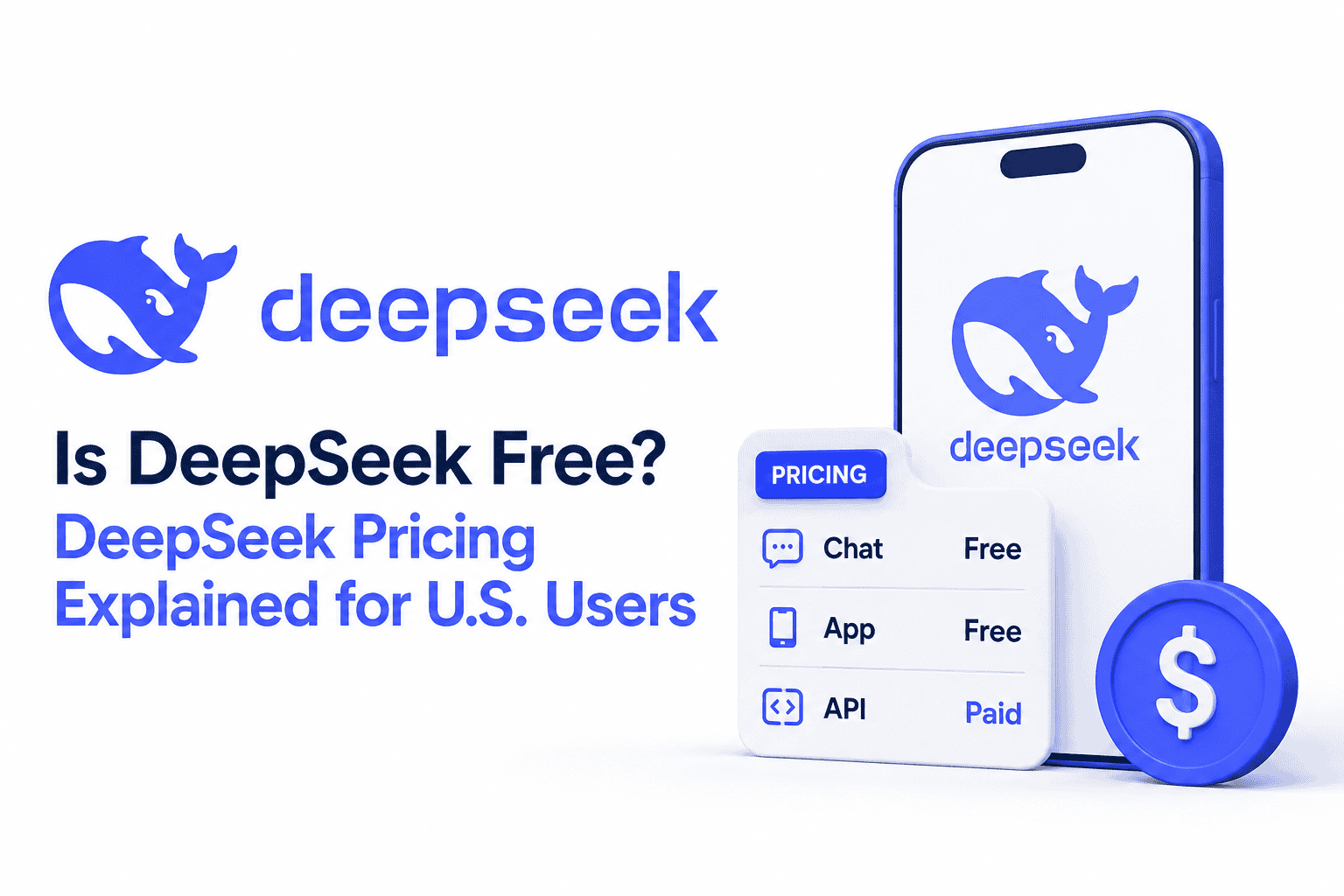
Is DeepSeek free? The practical answer is: the official DeepSeek app is listed as free on major app stores, but the DeepSeek API is paid. Some DeepSeek model weights are also available under permissive licenses, but downloading open weights is not the same as getting free hosted inference. If you run a model yourself, you still pay for hardware, cloud GPUs, storage, bandwidth, engineering time, and operations.
This distinction matters because “DeepSeek free” can mean four different things: the consumer app, the web chat, the developer API, or open-weight models such as DeepSeek-R1 and DeepSeek-V4.1-Flash. Mixing those together leads to the wrong answer.
The practical choice depends on what you need: try the official free-to-download app for everyday chat, use the metered API to build software, and evaluate open weights when you can manage the license and computing requirements. Do not rely on old R1-era model names or pricing to budget a current API project.
Quick answer: what is free and what is paid?
DeepSeek AI is free in some contexts and paid in others.
| DeepSeek option | Is it free? | What it means in practice |
|---|---|---|
| Official mobile app | Listed as free | Google Play says users can interact with DeepSeek’s official AI assistant for free, and the Apple App Store lists the app as “Free.” |
| DeepSeek web chat | May be free to access, but verify in your account | Official public pages link to DeepSeek Web, but fixed free-message limits or availability limits should be checked inside the current product. |
| DeepSeek API | No, API usage is paid | The API is priced per 1M tokens, with separate cache-hit input, cache-miss input, and output prices. |
| DeepSeek-R1 open weights | Free to access under the model-card license terms | The R1 model card lists an MIT license and supports commercial use, but running the model is not free. |
| DeepSeek-V4.1-Flash open weights | Free to access under the model-card license terms | The Hugging Face model card lists an MIT license, but serious inference requires infrastructure. |
| Third-party DeepSeek hosting | Usually not free | Third-party inference providers can charge their own prices even when the underlying model weights are open. |
| Self-hosting | No, not really | You may not pay DeepSeek API fees, but you pay compute, storage, serving, monitoring, and maintenance costs. |
Is the DeepSeek app free?
Yes, the official DeepSeek mobile app is listed as free in the app stores checked for this article.
The Google Play listing for DeepSeek – AI Assistant says: “Experience seamless interaction with DeepSeek’s official AI assistant for free.” It also identifies the developer as DeepSeek and lists the app as a productivity app.
The Apple App Store listing for DeepSeek – AI Assistant displays the app price as “Free” and uses similar wording: “Experience seamless interaction with DeepSeek’s official AI assistant for free.”
That means a normal user can usually start with the official app without paying an API bill. However, “free app” does not necessarily mean unlimited usage, guaranteed uptime, no queueing, no account controls, or no future plan changes. The official app-store listings checked here do not clearly publish a fixed free-message limit, so users should expect practical limits, availability constraints, or account-level controls to change over time.
Is DeepSeek web chat free?
DeepSeek’s official website links to DeepSeek Web, but public pages checked for this article do not clearly publish a fixed free-message allowance, session limit, or web-specific pricing table for normal chat users.
So the practical answer is: DeepSeek web chat may be available as a free consumer experience, but you should verify current access, login requirements, and limits inside the product itself. Do not assume web chat and the developer API follow the same pricing model.
Is DeepSeek API free?
No. DeepSeek API usage is a separate developer product with token-based pricing.
DeepSeek’s Models & Pricing page says prices are listed per 1M tokens and that billing is based on the total number of input and output tokens used by the model. It also says expenses are deducted from the user’s topped-up balance or granted balance, with granted balance used first when both are available.
For balance checks and top-ups, use our DeepSeek API billing guide.
This means the API is not “free” simply because the consumer app is free. If you are building a product, integration, automation, chatbot, agent, or backend service, you should treat DeepSeek API as a paid service and check current pricing before deployment.
DeepSeek API pricing explained
DeepSeek charges for three separately measured token categories: cache-hit input, cache-miss input, and output. The model and the peak/off-peak window determine which rates apply. All prices in the table below are US dollars per 1,000,000 tokens, not dollars per token or dollars per request. Official DeepSeek Models & Pricing.
On October 9, 2026, the official DeepSeek pricing table listed these direct-provider API rates (USD per 1M tokens):
| Model | Cached input (USD / 1M tokens) | Uncached input (USD / 1M tokens) | Output (USD / 1M tokens) | Notes |
|---|---|---|---|---|
deepseek-flash off-peak | $0.003 | $0.15 | $0.60 | DeepSeek-V4.1-Flash, off-peak pricing. |
deepseek-flash peak | $0.006 | $0.30 | $1.20 | Peak pricing is double off-peak pricing. |
deepseek-v4-pro off-peak | $0.022 | $0.66 | $1.98 | DeepSeek-V4-Pro-0813 pricing in the current table. |
deepseek-v4-pro peak | $0.044 | $1.32 | $3.96 | Peak pricing is double off-peak pricing. |
DeepSeek’s pricing page says peak hours are 01:00–04:00 and 06:00–10:00 UTC, Monday through Friday, excluding Chinese public holidays. All other hours are off-peak, including weekends and Chinese public holidays in full.
Low token rates are not free usage. Cached-prefix input is billed at the cache-hit rate only when DeepSeek actually reports a hit, and generated tokens continue to incur output charges. Peak rates are double the corresponding off-peak rates in this table. Do not compare cached-input prices alone when estimating the cost of an entire request.
How DeepSeek API cost works
The pricing table above quotes rates per one million tokens. To calculate a particular request, separate the input tokens that hit DeepSeek’s context cache from those that missed, then add the generated output. Use the rates for the same model and billing window.
- Cache-hit input tokens: prompt tokens that DeepSeek reports as having reused a persisted prefix.
- Cache-miss input tokens: prompt tokens that are billed at the uncached-input rate.
- Output tokens: generated tokens billed at the output rate, whether or not some input was cached.
Correct formula when each rate is in USD per 1 million tokens:
request_cost_usd = (
    cache_hit_input_tokens  * cache_hit_rate_per_1m
  + cache_miss_input_tokens * cache_miss_rate_per_1m
  + output_tokens           * output_rate_per_1m
) / 1,000,000
Dividing by 1,000,000 is essential. Without it, multiplying token counts by the displayed per-million rates overstates the result by a factor of one million. The figures below are hypothetical examples using published prices—not live API measurements.
Example: DeepSeek Flash cost with cached input
Assume a deepseek-flash request made off-peak uses 80,000 cache-hit input tokens, 20,000 cache-miss input tokens, and 2,000 output tokens. The correct billable token-cost estimate is:
| Token category | Tokens | Rate (USD / 1M) | Estimated cost |
|---|---|---|---|
| Cache-hit input | 80,000 | $0.003 | $0.00024 |
| Cache-miss input | 20,000 | $0.15 | $0.00300 |
| Generated output | 2,000 | $0.60 | $0.00120 |
| Total | 102,000 | — | $0.00444 |
Cached input:   80,000 / 1,000,000 * $0.003 = $0.00024
Uncached input: 20,000 / 1,000,000 * $0.15  = $0.00300
Output:          2,000 / 1,000,000 * $0.60  = $0.00120
---------------------------------------------------
Total estimated token charge:                   $0.00444
What if none of those input tokens hit the cache?
Keep the same 100,000 input tokens, 2,000 output tokens, model, and off-peak rates, but assume all input tokens are cache misses. The input cost becomes 100,000 / 1,000,000 * $0.15 = $0.01500. Adding the unchanged output cost of $0.00120 gives $0.01620 for that hypothetical all-miss request.
The comparison is $0.00444 with the assumed cache hits versus $0.01620 without them—a difference of $0.01176 for this example. That is a scenario comparison, not a guaranteed saving: cache hits are best-effort, real requests can produce different output lengths, peak-hour rates are different, and an application may incur other operating costs. Confirm hit and miss counts from the API response instead of assuming repeated text is always cached. See our DeepSeek Context Caching guide and DeepSeek’s official caching documentation.
For long-running agents, repeated documents, codebase analysis, or retrieval-augmented generation (RAG), estimate total request costs using the observed token mix, not just the cheaper cached-input rate. Output tokens remain billable, and a free consumer chatbot does not make API usage free.
Is DeepSeek R1 free?
DeepSeek-R1 is available as open weights, but that is not the same as a free hosted service.
The official DeepSeek-R1 model card on Hugging Face lists the license as MIT. The model card also says the DeepSeek-R1 series supports commercial use and allows modifications and derivative works, including distillation for training other LLMs. It also notes license considerations for the Qwen-derived and Llama-derived distilled models.
So if by “free” you mean “can I access the model weights under the model-card license terms?” the answer is yes. If by “free” you mean “can I run R1 at scale without paying for compute?” the answer is no.
Another important warning: older articles may talk about DeepSeek R1 and deepseek-reasoner as if they are the current API path. DeepSeek’s Change Log shows that deepseek-reasoner was originally introduced for DeepSeek-R1 in January 2025, later upgraded to R1-0528, then mapped through newer thinking modes, and eventually listed as a legacy API name scheduled for discontinuation. Do not use old R1 API guidance as current pricing or current model guidance.
Are DeepSeek open-weight models free?
Some DeepSeek models are available as open weights, but “open weights” does not mean “free hosted inference.”
The DeepSeek-V4.1-Flash Hugging Face model card lists the license as MIT and says the repository and model weights are licensed under the MIT License. The card describes V4.1 Flash as a multimodal Mixture-of-Experts model with 552B backbone parameters and support for contexts up to one million tokens.
Open-weight access can be valuable for research, evaluation, custom deployments, and teams that need more control. But running large models is expensive. You may need GPUs, storage, inference software, monitoring, security, engineers, and ongoing operations. If you use a third-party inference provider, that provider may charge its own prices even when the underlying model weights are open.
| Question | Answer |
|---|---|
| Can the weights be available under a permissive license? | Yes, for model cards that list MIT or another permissive license. |
| Does that make the official hosted API free? | No. API usage is billed separately. |
| Does that make local inference free? | No. You still pay for compute, storage, electricity or cloud infrastructure, and operations. |
| Can third-party hosts charge for DeepSeek models? | Yes. Serving a model is a separate service from publishing model weights. |
| Should businesses check the license? | Yes. Also check base-model license notes for distilled variants. |
What “free” does not include
When people ask whether DeepSeek is free, they often mean “Can I use it without paying today?” But for serious use, free access does not cover every requirement.
- Guaranteed availability: Free app access may still face busy servers, queues, account controls, or changing limits.
- API usage: Developers pay token-based API fees.
- Output tokens: Context caching only reduces cached input cost; generated output still costs money in the API.
- Self-hosting: Open weights still require compute and operations.
- Business controls: Teams may need vendor review, security controls, admin features, logging, and data-processing terms.
- Privacy review: Free access does not mean your prompts are private by default.
- Third-party apps: A third-party app using DeepSeek may have different pricing, data handling, and limits from DeepSeek’s official app.
Free app vs API vs open weights
| Use case | Best option | Cost expectation | What to verify |
|---|---|---|---|
| Casual chat, study help, writing help | Official DeepSeek app or web chat | App-store listings show the app as free. | Account requirements, availability, and any practical usage limits. |
| Building an app, bot, workflow, or backend service | DeepSeek API | Paid token pricing. | Current model names, pricing, context caching, and output cost. |
| Researching or testing model weights | Open weights on Hugging Face | Weights may be available under license, but compute is paid by you or your provider. | License terms, hardware requirements, inference stack, and serving cost. |
| Business or regulated use | Work-approved deployment or approved API/vendor path | May require paid infrastructure or vendor review. | Privacy policy, terms, data location, security, and compliance requirements. |
| Using a third-party DeepSeek app | Depends on the app | Could be free, freemium, subscription, or paid. | Developer identity, pricing, privacy policy, and whether it is official. |
What about old R1 and deepseek-reasoner information?
Many older search results about DeepSeek focus on DeepSeek R1 and deepseek-reasoner. That history is important, but it can mislead users who want current pricing or current API instructions.
DeepSeek’s changelog says deepseek-reasoner was introduced as the API model name for DeepSeek-R1 in January 2025. It was later upgraded to DeepSeek-R1-0528. In 2026, DeepSeek moved to newer V4/V4.1 model names. The current Models & Pricing page lists deepseek-flash and deepseek-v4-pro, not R1, as the active model IDs shown in that table.
For hosted API work today, check DeepSeek Models & Pricing and DeepSeek Change Log before copying old R1 examples. For R1 specifically, use the official Hugging Face model cards and understand that open weights are different from the hosted API.
Is DeepSeek free compared with ChatGPT, Claude, or Gemini?
DeepSeek’s consumer app being listed as free can make it attractive compared with AI assistants that have free and paid tiers. But that does not mean DeepSeek is “free” in every context.
For developers, compare total API cost per successful task, not whether the consumer app is free or which provider has the lowest single token rate. DeepSeek charges for cached input, uncached input, and output at different rates. Other AI providers offer different model capabilities, tools, business terms, and integrations, so a useful comparison must control for task quality and actual token consumption.
For users, the better comparison is whether the free app does what you need reliably, safely, and within your comfort level for privacy and data use. For businesses, the better comparison is legal approval, privacy terms, admin controls, data handling, vendor risk, and total cost—not only the sticker price of a consumer chatbot.
Privacy considerations for free users
Free access does not automatically mean private access. Before pasting sensitive information into any AI assistant, check the provider’s privacy policy and data controls.
The Google Play Data safety section for DeepSeek says the app may share device or other IDs with third parties and may collect location, personal info, and other data types. It also says data is encrypted in transit and that users can request data deletion. The listing links to DeepSeek’s Privacy Policy.
For ordinary low-sensitivity prompts, users may decide the free app is acceptable. For sensitive personal, medical, financial, legal, client, source-code-secret, employee, student, or regulated information, do not paste it into DeepSeek unless you understand the policy and your organization has approved that use.
Before you use DeepSeek for free, check this
- Are you using the official DeepSeek app or a third-party app?
- Are you using the consumer app, web chat, developer API, or open weights?
- Are you entering sensitive personal, business, legal, medical, financial, or client data?
- Do you need guaranteed availability, logging, admin controls, or business approval?
- Are you relying on old R1 or
deepseek-reasonerinformation? - For API use, have you checked the current token pricing?
- For open weights, have you estimated compute, storage, and serving cost?
- Are you okay with practical limits or availability controls changing over time?
- Have you reviewed the privacy policy before uploading files or sharing sensitive prompts?
Who should use the free DeepSeek app?
The free app is the right starting point for most casual users who want to try DeepSeek for general questions, studying, brainstorming, writing help, coding explanations, translation, summarization, or everyday AI chat.
It is not the right substitute for a production API, an enterprise-approved AI environment, or a controlled deployment for sensitive data. If you need reliability guarantees, integration with your product, predictable throughput, logs, billing controls, or programmatic access, you need the API or another approved deployment path.
Who should use the paid DeepSeek API?
Use the API if you are building software around DeepSeek. Examples include:
- A customer support bot.
- A coding agent.
- A document analysis workflow.
- A RAG system.
- A backend automation tool.
- An internal productivity assistant.
- A product feature that calls DeepSeek programmatically.
For API use, budget around the actual token counts divided by one million, multiplied by each per-million rate, alongside context-cache performance, peak/off-peak timing, output length, retries, and concurrency. Monitor real usage and regularly recheck official DeepSeek prices because rates can change.
Common misconceptions about DeepSeek being free
| Misconception | More accurate answer |
|---|---|
| “DeepSeek is completely free.” | The official app is listed as free, but the API is paid and self-hosting costs money. |
| “DeepSeek API is free.” | No. DeepSeek publishes token-based API pricing. |
| “If the app is free, the API is free.” | No. Consumer app access and developer API billing are separate. |
| “DeepSeek R1 is the current free model everyone should use.” | R1 remains important as open weights, but current hosted API work should follow current model IDs such as deepseek-flash. |
| “Open weights mean free hosting.” | No. Open weights can be free to access, but inference requires compute and operations. |
| “There are no limits because the app says free.” | Free listing does not prove unlimited usage. Check the current app/account experience for practical limits. |
| “Free means no privacy tradeoff.” | No. Review DeepSeek’s privacy policy and avoid sensitive data unless you understand the handling. |
| “Third-party DeepSeek apps follow the same pricing.” | No. Third-party apps can set their own pricing, limits, and privacy terms. |
Frequently asked questions
Is DeepSeek free to use?
The official DeepSeek app is listed as free on Google Play and the Apple App Store. The developer API is not free; it uses token-based pricing.
Is the DeepSeek app free?
Yes. The app-store listings checked for this article list the official DeepSeek app as free and describe it as DeepSeek’s official AI assistant for free.
Is DeepSeek web free?
DeepSeek Web is an official entry point, but public pages checked here do not clearly publish a fixed free-message limit or web-specific pricing rule. Verify access and limits in the current product experience.
Is DeepSeek API free?
No. DeepSeek publishes metered API prices per 1M tokens. If your account has a granted balance, that balance may cover some charges until it is exhausted, but the underlying usage remains metered and paid according to the API schedule.
Does DeepSeek have a paid plan?
For consumers, the app-store listings checked here show the official app as free; they do not establish a permanent consumer subscription roadmap. Developers pay metered API prices, potentially offset by granted account balance. Check the current DeepSeek product and billing screens rather than assuming app access and API usage share a paid plan.
Does DeepSeek have usage limits?
Official app-store sources checked here do not clearly publish a fixed free-message limit. That does not mean unlimited use is guaranteed. Availability, account controls, and practical usage limits can change.
Is DeepSeek R1 free?
DeepSeek-R1 is available as open weights under the license terms shown on the model card. That makes the weights accessible, but running the model still costs compute, and old R1 API guidance may not reflect current hosted API model names.
Is DeepSeek open source?
Use precise wording: some DeepSeek model weights are openly available under licenses such as MIT. That is not the same as saying every DeepSeek product, hosted service, app, API, training process, or infrastructure is open source.
Are DeepSeek model weights free?
Some model weights, such as DeepSeek-R1 and DeepSeek-V4.1-Flash, are available on Hugging Face with MIT license labels. You still need to check the specific model card and pay for whatever compute is needed to run them.
Is self-hosting DeepSeek free?
No. Self-hosting may avoid DeepSeek API fees, but it introduces hardware, cloud, storage, bandwidth, engineering, monitoring, and maintenance costs.
Is DeepSeek free compared with ChatGPT?
The official DeepSeek app is listed as free, while many competing AI assistants offer both free and paid tiers. For API use, compare current token pricing, output length, caching, reliability, and total cost per successful task rather than app pricing alone.
Does DeepSeek show ads?
The app-store sources checked for this article list the app as free, but they do not provide a complete permanent guarantee about ads or future monetization. Verify the current app experience and official product pages.
Is DeepSeek free for commercial use?
It depends on what you mean. The DeepSeek-R1 model card says the R1 series supports commercial use under its listed license terms, but hosted API usage is paid and business use should still review legal, privacy, security, and licensing requirements.
Can businesses use DeepSeek for free?
A business can try the free app like any user, but that does not make it approved for sensitive work. Businesses should use an approved deployment path, review DeepSeek’s policies and terms, and budget for API or infrastructure costs if they are building with DeepSeek.
Does free DeepSeek use my data?
Free access does not mean no data collection. Review the app-store Data safety information and DeepSeek’s Privacy Policy before entering sensitive information or uploading files.
Is deepseek-reasoner still the free R1 model?
Do not treat deepseek-reasoner as the current default API model. DeepSeek’s changelog shows it as an older API name that changed over time and was later listed as a legacy name. Check current DeepSeek API documentation before using old R1 examples.
Bottom line
DeepSeek is free for many normal app users because the official mobile app is listed as free. But DeepSeek is not free in every context. The API is paid, open weights still require compute, third-party hosts may charge, and business use may require legal, privacy, and security review.
The best way to think about it is simple: DeepSeek app access can be free; DeepSeek API usage is paid; DeepSeek model weights may be open; running those weights is not free. If you are a casual user, start with the official app. If you are a developer, check the current API pricing. If you want open weights, check the exact model card and estimate real inference costs before you build around it.
Official sources checked
- DeepSeek – AI Assistant on Google Play
- DeepSeek – AI Assistant on the Apple App Store
- DeepSeek Models & Pricing
- DeepSeek V4.1 Flash release note
- DeepSeek V4.1 Flash API pricing image
- DeepSeek Change Log
- DeepSeek-V4.1-Flash model card on Hugging Face
- DeepSeek-R1 model card on Hugging Face
- DeepSeek Privacy Policy
- DeepSeek Terms of Use