
Last verified: October 10, 2026
DeepSeek V4.1 Flash is DeepSeek’s current Flash model route for the API. For new API code, the model name you should normally use is deepseek-flash, not deepseek-v4-flash or deepseek-v4-flash-vision-exp. DeepSeek’s official release note says V4.1 Flash is live on the API with native multimodal support, and DeepSeek’s current Models & Pricing page says to use deepseek-flash as the model name.
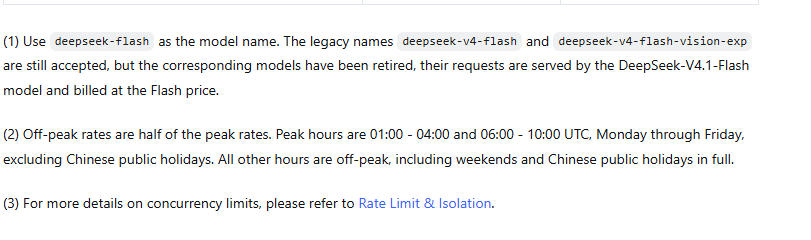
The short version: use deepseek-flash for new DeepSeek V4.1 Flash API integrations. Treat deepseek-v4-flash and deepseek-v4-flash-vision-exp as legacy compatibility names. DeepSeek says those older model names are still accepted, but the corresponding old models have been retired, and requests are served by DeepSeek-V4.1-Flash and billed at the Flash price. DeepSeek Models & Pricing
Do not confuse DeepSeek V4.1 Flash with DeepSeek R1, deepseek-reasoner, deepseek-chat, the old V4 Flash, or V4 Pro. V4.1 Flash is a newer Flash route with native visual understanding, a 1M-token context window, 384K maximum output in the current API table, and support for Thinking Mode, JSON Output, Tool Calls, Responses API, Anthropic API, Chat Prefix Completion, FIM in non-thinking mode, and Vision. DeepSeek V4.1 Flash release note DeepSeek Models & Pricing
DeepSeek originally announced on September 10, 2026, that requests to deepseek-v4-pro would begin routing to V4.1 Flash on September 14. That plan later changed. In response to user demand, DeepSeek’s official changelog says it will continue providing the V4 Pro API service after September 14, with the billing method unchanged. The current Models & Pricing page therefore lists deepseek-v4-pro as DeepSeek-V4-Pro-0813, separate from deepseek-flash, with its own prices, supported features, and concurrency limit. See the DeepSeek API changelog and the current model table.
Quick answer: should you use deepseek-flash?
Yes, for most new DeepSeek API projects, deepseek-flash should be the starting model name. It is the current API route for DeepSeek V4.1 Flash, and it is much cheaper than deepseek-v4-pro in the current pricing table.
| Question | Practical answer |
|---|---|
| What is the current V4.1 Flash API model name? | deepseek-flash. |
Should new code use deepseek-v4-flash? | No. Treat it as a legacy compatibility name, not the preferred current model ID. |
Should new code use deepseek-v4-flash-vision-exp for images? | No. Use deepseek-flash; Vision is supported there in the current model table. |
| Does V4.1 Flash support image input? | Yes. DeepSeek lists Vision support for deepseek-flash. |
| Is V4.1 Flash open weights? | The official Hugging Face model card lists DeepSeek-V4.1-Flash with an MIT license. |
| Is it free? | No. The hosted API is token-priced. Open weights and hosted API billing are separate things. |
Is deepseek-v4-pro gone? | No. DeepSeek’s later changelog reversed the previously announced routing plan and says V4 Pro API service continues after September 14, 2026, with billing unchanged. It remains listed separately as deepseek-v4-pro. |
What is DeepSeek V4.1 Flash?
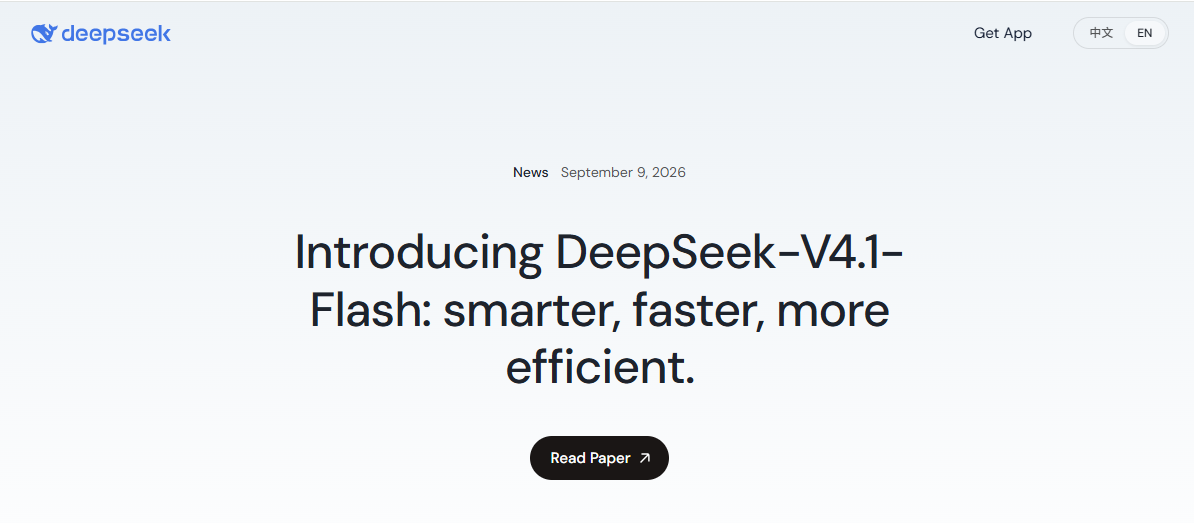
DeepSeek V4.1 Flash is a multimodal Mixture-of-Experts model in DeepSeek’s V4.1 family. DeepSeek describes it as the smallest model in its new architecture family, built for stronger capability, faster inference, higher throughput, and lower cost. The official release note says it has native visual understanding and is live on the DeepSeek API under the deepseek-flash model name. DeepSeek V4.1 Flash release note
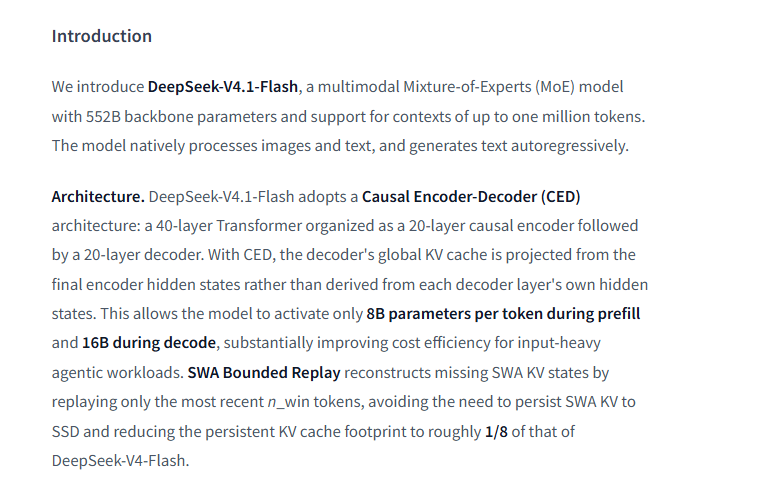
The official Hugging Face model card describes DeepSeek-V4.1-Flash as a multimodal MoE model with 552B backbone parameters and support for contexts up to one million tokens. It natively processes images and text and generates text autoregressively. DeepSeek-V4.1-Flash model card
For developers, the key practical point is not the model family name alone. It is the API model ID. In current DeepSeek API examples and the model table, V4.1 Flash is called with:
model="deepseek-flash"Old tutorials that tell you to use deepseek-v4-flash, deepseek-v4-flash-vision-exp, deepseek-chat, or deepseek-reasoner should be checked against the current DeepSeek docs before you copy them.
Current model status: V4.1 Flash, V4 Flash, V4 Pro, R1, and old aliases
Use this table to avoid model-name mistakes.
| Item | What it is | Current official status | Should you use it today? | Practical note |
|---|---|---|---|---|
| DeepSeek V4.1 Flash | Current Flash model route. | Officially live on the API with native multimodal support. | Yes, for most new Flash/API use cases. | Use the API model name deepseek-flash. |
deepseek-flash | API model ID for DeepSeek-V4.1-Flash. | Current model name in the Models & Pricing page. | Yes. | Best default starting point for new DeepSeek API projects. |
| DeepSeek V4 Flash | Older Flash route before V4.1 Flash. | Retired according to the V4.1 Flash release note. | No, not as a new-code target. | Use deepseek-flash instead. |
deepseek-v4-flash | Legacy V4 Flash API name. | Still accepted for compatibility, but requests are served by V4.1 Flash. | Avoid in new code. | Keep only for legacy compatibility while migrating. |
| DeepSeek V4 Flash Vision Exp | Older experimental multimodal V4 Flash route. | Retired according to the V4.1 Flash release note. | No, not as a new-code target. | Use deepseek-flash for Vision. |
deepseek-v4-flash-vision-exp | Legacy experimental Vision API name. | Still accepted for compatibility, but requests are served by V4.1 Flash. | Avoid in new code. | Do not use it as the current Vision model name. |
| DeepSeek V4 Pro | Pro route from the V4 family. | Active separate API service. DeepSeek’s changelog says it continues after September 14, 2026, with billing unchanged. | Yes, when your evaluation and requirements justify the Pro route. | Use deepseek-v4-pro; do not treat the superseded routing announcement as the current policy. |
deepseek-v4-pro | API model ID for V4 Pro. | Current API model ID for DeepSeek-V4-Pro-0813, listed separately from Flash. | Yes, for workloads that benefit from Pro after testing. | It has separate pricing, no Vision support in the current table, and a 500-request account concurrency limit. |
| DeepSeek R1 | Historical/open-weight reasoning model family. | Important as open weights and historical reasoning model, but not the current Flash API route. | Use only when you specifically need R1/open-weight reasoning behavior. | Do not treat R1 as the current DeepSeek API default. |
deepseek-reasoner | Old reasoning API alias used in R1-era examples. | Older changelog entries tied it to R1/R1-0528, but later V4 entries moved current API guidance elsewhere. | Do not use as the default for new V4.1 Flash examples. | Check the current changelog before using old R1 tutorials. |
deepseek-chat | Old general chat API alias. | Older DeepSeek API history used it for previous model generations. | Do not use as the default in new V4.1 Flash examples. | Use current model IDs from the Models & Pricing page. |
Correct API model name and legacy names
The correct current API model name for DeepSeek V4.1 Flash is:
deepseek-flashDeepSeek’s current pricing page explicitly says to use deepseek-flash as the model name. It also says the legacy names deepseek-v4-flash and deepseek-v4-flash-vision-exp are still accepted, but the corresponding models have been retired, and their requests are served by DeepSeek-V4.1-Flash and billed at the Flash price. DeepSeek Models & Pricing
A current OpenAI-format request should look like this:
{
  "model": "deepseek-flash",
  "messages": [
    {"role": "system", "content": "You are a helpful assistant."},
    {"role": "user", "content": "Explain DeepSeek V4.1 Flash in one paragraph."}
  ],
  "thinking": {"type": "enabled"},
  "reasoning_effort": "high",
  "stream": false
}
Do not write new examples with deepseek-v4-flash unless the section is explicitly about legacy migration.
What happened to deepseek-v4-pro?
DeepSeek’s September 10 V4.1 Flash release note announced that deepseek-v4-pro requests would start routing to V4.1 Flash on September 14, 2026. That announcement explains why older articles and screenshots describe Pro as being phased out. DeepSeek V4.1 Flash release note
The announced conversion did not become the current policy. DeepSeek later updated its official changelog in response to user demand and said it would continue providing the V4 Pro API service after September 14, with the billing method unchanged. The current Models & Pricing page confirms the result by listing deepseek-v4-pro as DeepSeek-V4-Pro-0813, separately from deepseek-flash. DeepSeek API changelog DeepSeek Models & Pricing
V4 Pro therefore remains a distinct hosted API option with its own prices, feature support, and account-level concurrency limit. Its current table row supports thinking and non-thinking modes, JSON Output, Tool Calls, Responses API, Anthropic API, Chat Prefix Completion, and FIM in non-thinking mode, but not Vision. For a model-focused explanation, see our DeepSeek V4 Pro guide.
The practical guidance is:
- Use
deepseek-flashfor V4.1 Flash, including current Vision/image-input workflows. - Use
deepseek-v4-proonly when you intentionally want the separately listed V4 Pro route. - Do not describe Pro as retired, stopped, or automatically converted to Flash under the current policy.
- Do not apply Flash prices, Vision support, or Flash’s 2500-request concurrency limit to Pro.
- Test both models on representative tasks before migrating; separate availability does not prove that Pro is better for every workload.
Key specs and architecture
The model card and technical-report text describe DeepSeek-V4.1-Flash as a multimodal MoE model designed to reduce input-heavy agent costs and improve efficiency.
| Spec | DeepSeek V4.1 Flash | Source context |
|---|---|---|
| Model type | Multimodal Mixture-of-Experts model. | Official Hugging Face model card / technical report. |
| Backbone parameters | 552B backbone parameters. | Model-card introduction. |
| Architecture | Causal Encoder–Decoder architecture. | Technical-report section on architecture. |
| Active parameters | 8B active parameters during prefill and 16B during decode. | Technical-report architecture description. |
| Context length | Up to 1M tokens. | Model card and current DeepSeek API table. |
| Max output in API table | 384K. | Current Models & Pricing page. |
| Multimodal support | Native image and text processing. | Release note and model card. |
| Vision support in API | Supported for deepseek-flash. | Current Models & Pricing feature table. |
| License on Hugging Face | MIT. | Official Hugging Face model card. |
The technical-report text says the model’s Causal Encoder–Decoder design projects the decoder’s global KV cache from encoder hidden states rather than deriving it from every decoder layer. It also says this allows lower active parameter counts during prefill and decode, which is why DeepSeek frames V4.1 Flash as especially useful for input-heavy agentic workloads. DeepSeek-V4.1-Flash model card
API features supported by deepseek-flash
DeepSeek’s current model table lists these features for deepseek-flash:
| Feature | Supported by deepseek-flash? | Practical use |
|---|---|---|
| Thinking Mode | Yes. | Use for reasoning, coding, agents, technical analysis, and complex tasks. |
| Non-thinking mode | Yes. | Use for fast, simpler, formatting-sensitive, or deterministic tasks. |
| JSON Output | Yes. | Use for structured extraction, classification, and machine-readable responses. |
| Tool Calls | Yes. | Use for function-calling and agent workflows where your app executes controlled tools. |
| Responses API | Yes. | Use for OpenAI Responses API-style workflows. |
| Anthropic API | Yes. | Use with Anthropic-compatible clients and tools through DeepSeek’s Anthropic-format base URL. |
| Chat Prefix Completion | Yes, listed as Beta. | Use only when this completion pattern fits your app. |
| FIM Completion | Yes, in non-thinking mode only. | Use for fill-in-the-middle code/completion workflows. |
| Vision | Yes. | Use for image input and visual understanding. |
| Context length | 1M. | Use for long documents, repeated context, codebases, and long agent workflows. |
| Max output | 384K maximum in the current API table. | Useful for long generated outputs, but watch cost and latency. |
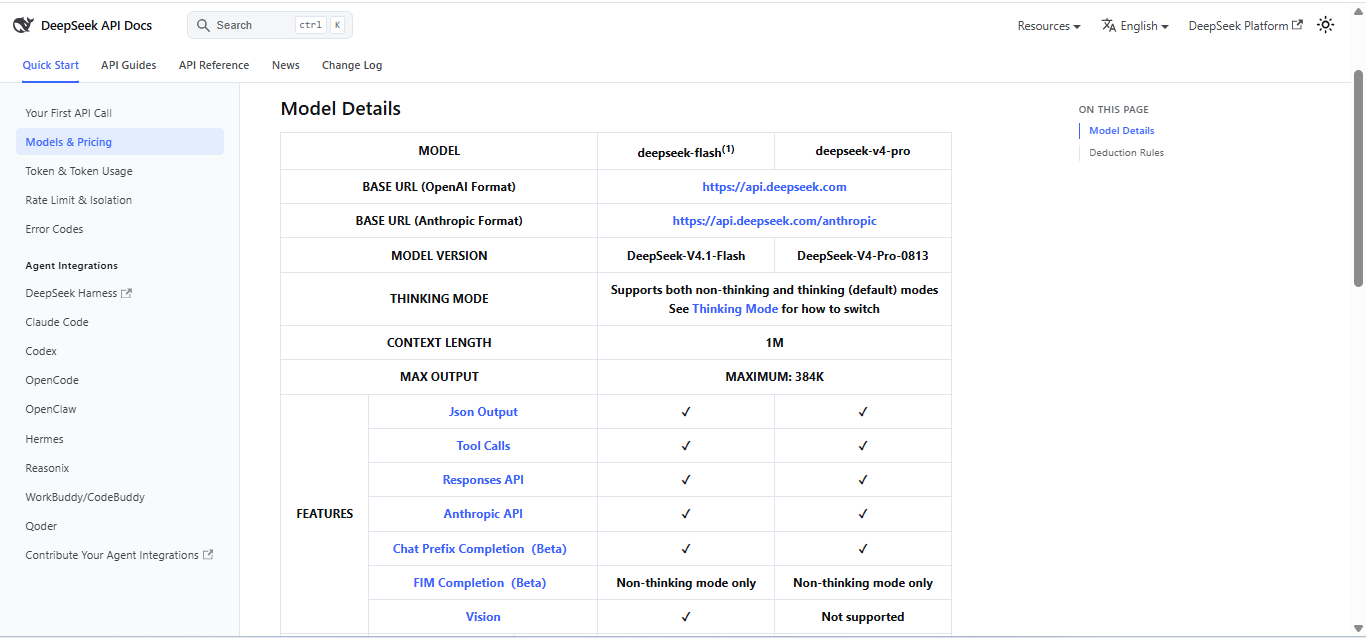
The same current model table lists deepseek-v4-pro as supporting many non-vision features, but Vision is listed as not supported for deepseek-v4-pro. If you need image input through the official DeepSeek API, use deepseek-flash. DeepSeek Models & Pricing
Pricing and concurrency
DeepSeek’s pricing table uses USD per 1M tokens. It separates cache-hit input, cache-miss input, and output tokens. It also uses peak and off-peak rates, with off-peak rates at half of peak rates. DeepSeek Models & Pricing
| Model | Input cache hit | Input cache miss | Output | Concurrency limit |
|---|---|---|---|---|
deepseek-flash off-peak | $0.003 / 1M tokens | $0.15 / 1M tokens | $0.60 / 1M tokens | 2500 |
deepseek-flash peak | $0.006 / 1M tokens | $0.30 / 1M tokens | $1.20 / 1M tokens | 2500 |
deepseek-v4-pro off-peak | $0.022 / 1M tokens | $0.66 / 1M tokens | $1.98 / 1M tokens | 500 |
deepseek-v4-pro peak | $0.044 / 1M tokens | $1.32 / 1M tokens | $3.96 / 1M tokens | 500 |
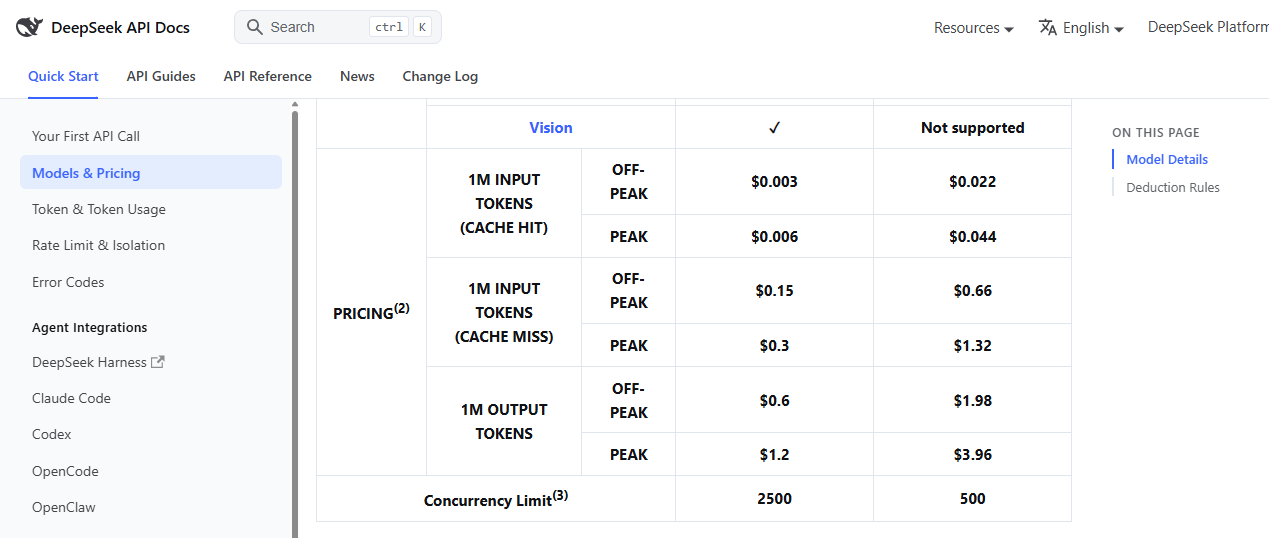
DeepSeek says peak hours are 01:00–04:00 and 06:00–10:00 UTC, Monday through Friday, excluding Chinese public holidays. All other hours are off-peak, including weekends and full Chinese public holidays. Because pricing can change, DeepSeek recommends regularly checking the pricing page for the most recent pricing information. DeepSeek Models & Pricing
The practical takeaway: V4.1 Flash is much cheaper than the separately listed V4 Pro route for both input and output tokens. That price difference reflects two active model choices, not a Pro request being silently rebilled as Flash. Do not ignore output cost, peak/off-peak timing, cache-hit rate, retries, and concurrency.
DeepSeek V4.1 Flash vs V4 Pro
DeepSeek V4.1 Flash and V4 Pro are currently separate API choices. DeepSeek’s V4 Pro GA release described Pro as an agent-focused model with reasoning-effort control and Responses API support, and DeepSeek’s later changelog confirms that V4 Pro service continues after September 14, 2026. DeepSeek V4 Pro GA release note DeepSeek API changelog
The September 10 V4.1 Flash announcement had proposed routing Pro requests to Flash, but DeepSeek later changed that plan in response to user demand. The current pricing page lists deepseek-flash as DeepSeek-V4.1-Flash and deepseek-v4-pro as DeepSeek-V4-Pro-0813, with different rates, Vision support, and concurrency limits. Compare DeepSeek Flash with V4 Pro rather than treating the older phase-out announcement as the live policy. DeepSeek Models & Pricing
| Comparison point | deepseek-flash / V4.1 Flash | deepseek-v4-pro / V4 Pro |
|---|---|---|
| Current model table status | Listed as DeepSeek-V4.1-Flash. | Listed as DeepSeek-V4-Pro-0813. |
| Best default for new projects | Yes, for most cost-sensitive API work. | No, only use if current docs and your evaluation justify it. |
| Vision | Supported. | Not supported in the current model table. |
| Cost | Much lower. | Higher. |
| Concurrency limit | 2500. | 500. |
| Current service status | Current V4.1 Flash API route under deepseek-flash. | Continues as an independent API service after the previously announced conversion plan was changed. |
DeepSeek V4.1 Flash vs V4 Flash and V4 Flash Vision Exp
V4.1 Flash replaced the old V4 Flash and V4 Flash Vision Exp routes as the current Flash model. DeepSeek’s official release note says V4 Flash and V4 Flash Vision Exp are retired, and that deepseek-v4-flash and deepseek-v4-flash-vision-exp temporarily route to V4.1 Flash for compatibility. DeepSeek V4.1 Flash release note
That means old code may still appear to work, but it is not a good reason to keep using legacy names in new tutorials, apps, or documentation. Updating to deepseek-flash makes your code easier to understand and reduces confusion when debugging model behavior or billing.
Open weights and self-hosting
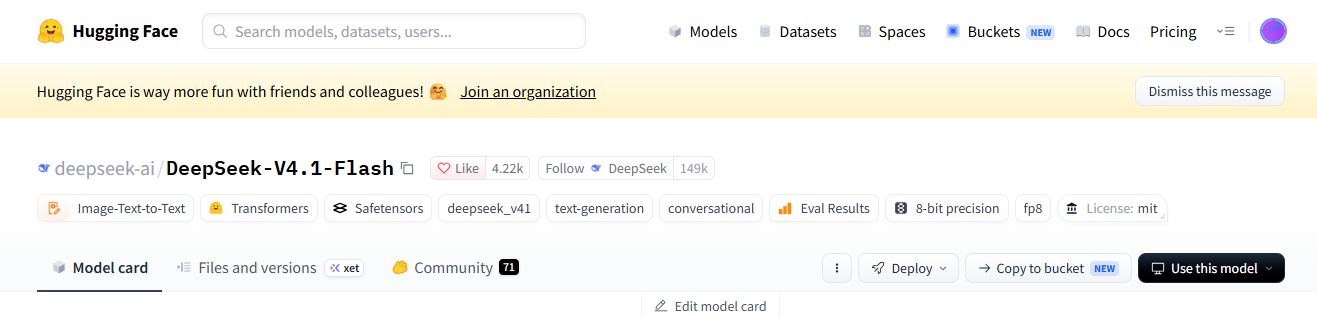
DeepSeek-V4.1-Flash has an official Hugging Face model card. The page lists the license as MIT and provides usage paths for libraries, inference providers, notebooks, vLLM, SGLang, Docker Model Runner, and compatible local apps. DeepSeek-V4.1-Flash model card
Open weights do not mean free hosted inference. If you call the DeepSeek hosted API, you pay the API token prices. If you self-host or use an inference provider, you pay in hardware, cloud GPU rental, storage, engineering time, monitoring, reliability, and security. Large MoE model deployment is not the same as running a small local model on a laptop.
Use the open-weight model card when you need local experimentation, model inspection, custom deployment, or third-party provider testing. Use the DeepSeek hosted API when you need easier integration and do not want to operate inference infrastructure.
When to use DeepSeek V4.1 Flash
DeepSeek V4.1 Flash is a strong starting point when cost, long context, throughput, image input, and agent workflows matter.
| Use case | Why V4.1 Flash fits | What to verify |
|---|---|---|
| High-volume API calls | Low token prices and high concurrency limit make it attractive for volume. | Peak/off-peak timing, output length, retries, and cache-hit rate. |
| Agentic coding | DeepSeek positions V4.1 Flash strongly for agent and coding tasks, and the model card includes agent benchmark tables. | Test on your own repositories and CI tests. |
| Long-context workflows | The API table and model card describe a 1M context window. | Quality over very long context still needs task-specific evaluation. |
| Image understanding | Vision is supported for deepseek-flash. | Image formats, input size limits, and exact API behavior in the Vision docs. |
| Structured extraction | JSON Output is supported in the current feature table. | Validate JSON in your application; do not rely on model output blindly. |
| Tool-calling agents | Tool Calls and Responses API are supported. | Validate tool names and arguments before execution. |
| Anthropic-compatible tools | Anthropic API support is listed in the model table. | Model mapping and billing behavior in the current Anthropic API docs. |
| Open-weight experiments | Model card lists MIT license and deployment paths. | Hardware, serving stack, cost, and license fit. |
When not to use DeepSeek V4.1 Flash
V4.1 Flash should not be treated as the answer to every problem. Consider another route when:
- You need a feature not supported by
deepseek-flash. - Your internal benchmark shows another model performs better on your exact workload.
- Your privacy, legal, or compliance rules do not allow sending data to a hosted API.
- Your evaluation shows that the separately available
deepseek-v4-proroute is the better fit for the workload. - Your third-party inference provider exposes smaller context, different output limits, or missing tool features.
- Your workload is output-heavy enough that output token cost dominates the savings from cheap input tokens.
- You plan to self-host but do not have the infrastructure, monitoring, and reliability capacity to operate a large MoE model.
Common mistakes from old tutorials
Many DeepSeek tutorials were written before V4.1 Flash. These are the most common mistakes to avoid.
| Old mistake | Why it is a problem | Use this instead |
|---|---|---|
Using deepseek-v4-flash in new code. | It is now a legacy compatibility name. | Use deepseek-flash. |
Using deepseek-v4-flash-vision-exp for image input. | The old Vision experimental model is retired. | Use deepseek-flash, which supports Vision. |
Assuming deepseek-v4-pro is definitely gone. | DeepSeek changed the announced conversion plan and continues the Pro API service. | Treat deepseek-v4-pro as a separate current route with its own model identity, capabilities and pricing. |
Using deepseek-reasoner as the current default. | It belongs to older R1-era guidance and should not be used as the default for V4.1 Flash. | Use current model IDs from the model table. |
| Calling V4.1 Flash “R1.” | R1 and V4.1 Flash are different model families/use cases. | Say DeepSeek V4.1 Flash or deepseek-flash. |
| Assuming open weights mean free API usage. | Hosted API billing and model weights are separate. | Separate hosted API cost from self-hosting cost. |
| Ignoring cache-hit vs cache-miss pricing. | Input-heavy workflows can have very different cost profiles. | Track cache-hit, cache-miss, and output tokens separately. |
Developer checklist before using V4.1 Flash in production
- Use
deepseek-flashas the model name for new V4.1 Flash code. - Do not use
deepseek-v4-flashordeepseek-v4-flash-vision-expin new examples. - Check whether your app needs Thinking Mode or non-thinking mode.
- Use
deepseek-flashfor Vision/image input. - Track input cache-hit, input cache-miss, and output tokens separately.
- Schedule flexible workloads off-peak when possible.
- Keep
deepseek-flashanddeepseek-v4-proas separate configuration choices; do not implement the superseded automatic-conversion assumption. - Validate JSON Output in application code before saving or executing anything.
- Validate Tool Call names and arguments before running functions.
- Do not send sensitive or regulated data without privacy/legal approval.
- If self-hosting, budget for infrastructure, monitoring, security, and reliability.
- Keep model IDs in configuration, not hard-coded across your codebase.
Frequently asked questions
What is DeepSeek V4.1 Flash?
DeepSeek V4.1 Flash is DeepSeek’s current Flash model route. It is a multimodal MoE model with native image and text processing, and it is called through the API with the deepseek-flash model name.
Is DeepSeek V4.1 Flash current?
Yes. DeepSeek’s current Models & Pricing page lists deepseek-flash as DeepSeek-V4.1-Flash. The page also says the old V4 Flash names are legacy compatibility names served by V4.1 Flash.
What model name should I use for DeepSeek V4.1 Flash?
Use deepseek-flash. That is the current API model name for DeepSeek V4.1 Flash.
Is deepseek-flash the same as DeepSeek V4.1 Flash?
Yes. DeepSeek’s current model table identifies deepseek-flash as DeepSeek-V4.1-Flash.
Is deepseek-v4-flash retired?
DeepSeek says the old V4 Flash model is retired. The legacy model name deepseek-v4-flash is still accepted for compatibility, but requests are served by DeepSeek-V4.1-Flash and billed at the Flash price.
Is deepseek-v4-flash-vision-exp retired?
Yes, DeepSeek says V4-Flash-Vision-Exp is retired. The legacy name is still accepted for compatibility, but new code should use deepseek-flash for Vision.
Does DeepSeek V4.1 Flash support image input?
Yes. DeepSeek’s current model table lists Vision support for deepseek-flash, and the model card describes native image-and-text processing.
Does DeepSeek V4.1 Flash support Thinking Mode?
Yes. The current model table says deepseek-flash supports both non-thinking and thinking modes, with thinking mode as the default.
Does DeepSeek V4.1 Flash support Tool Calls?
Yes. Tool Calls are listed as supported for deepseek-flash in the current model table.
Does DeepSeek V4.1 Flash support JSON Output?
Yes. JSON Output is listed as supported for deepseek-flash.
What is the context length of DeepSeek V4.1 Flash?
DeepSeek’s current model table lists a 1M-token context length, and the official model card says DeepSeek-V4.1-Flash supports contexts up to one million tokens.
What is the max output of DeepSeek V4.1 Flash?
The current Models & Pricing page lists a maximum output of 384K for deepseek-flash.
How much does DeepSeek V4.1 Flash cost?
In the current pricing table, deepseek-flash costs $0.003 per 1M cache-hit input tokens, $0.15 per 1M cache-miss input tokens, and $0.60 per 1M output tokens off-peak. Peak prices are double those values. Always check the current pricing page before production use.
Is DeepSeek V4.1 Flash open source?
Use precise language. The official Hugging Face page lists DeepSeek-V4.1-Flash with an MIT license and model weights, so it is better described as open weights under the listed license. Hosted API use is separate and is still billed by tokens.
Can I self-host DeepSeek V4.1 Flash?
The Hugging Face model card lists deployment paths such as Transformers, vLLM, SGLang, Docker Model Runner, and local apps. But self-hosting a large MoE model requires serious compute, storage, engineering, monitoring, and security planning.
Is DeepSeek V4.1 Flash better than V4 Pro?
DeepSeek’s V4.1 Flash release reported results ahead of V4 Pro on several dimensions, but that is not a universal workload verdict. V4 Pro remains available as a separate API service. Compare accuracy, latency, token usage, features, and total cost on your own tasks before choosing.
Does deepseek-v4-pro still work?
Yes. DeepSeek’s official changelog says V4 Pro API service continues after September 14, 2026, with billing unchanged. The current model table lists deepseek-v4-pro as DeepSeek-V4-Pro-0813 with separate prices, feature support, and a concurrency limit of 500. The earlier plan to route Pro requests to Flash was changed. DeepSeek API changelog
Should I use DeepSeek R1 or V4.1 Flash?
Use V4.1 Flash for current hosted API work unless you specifically need R1 as an open-weight reasoning model. R1 remains historically important, but old R1-era API examples should not be treated as current V4.1 Flash guidance.
Is deepseek-reasoner still the model to use?
Do not use deepseek-reasoner as the default for new DeepSeek V4.1 Flash tutorials. Use current model IDs from the live Models & Pricing page, especially deepseek-flash for V4.1 Flash.
Bottom line
DeepSeek V4.1 Flash is currently best understood as the official Flash route behind the deepseek-flash API model name. For new code, prefer deepseek-flash. Treat deepseek-v4-flash and deepseek-v4-flash-vision-exp as legacy compatibility names, not preferred current model IDs.
V4.1 Flash is attractive because it combines low token pricing, 1M context, 384K maximum output, Thinking Mode, JSON Output, Tool Calls, Responses API, Anthropic API, FIM in non-thinking mode, Vision, and open-weight availability through the official Hugging Face model card. It should usually be the first DeepSeek API model developers evaluate for new cost-sensitive, input-heavy, long-context, multimodal, and agentic workflows.
V4 Pro is no longer an unresolved caveat: DeepSeek changed the previously announced conversion plan and continues deepseek-v4-pro as a separate service with unchanged billing. Use deepseek-flash for V4.1 Flash and deepseek-v4-pro only when you deliberately choose Pro. Keep the model IDs, prices, Vision support, and concurrency limits separate.